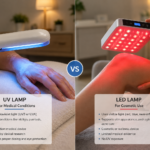

A patient walks in after six months of clobetasol with plaques still sitting on the elbows and shins, and asks the obvious question – is there something else. Phototherapy is usually where that conversation lands. A subset of those patients then asks the next question: can I do this at home instead of driving across town three times a week. Fair question. The answer depends almost entirely on where they buy the device.
The US market for UV lamps is not tidy. FDA-cleared medical hardware sits on the same search results page as cosmetic lamps, imported units of unclear provenance, and a handful of products that have already drawn FDA warning letters. So where to buy UV lamp US is really a clinical question, not a shopping one, and patients who skip the verification step tend to regret it. If you intend to buy a UV lamp USA-side for actual skin disease, the sourcing decision matters as much as the device itself.
What to Look for When Buying a UV Lamp
Wavelength is the first thing I want to see on a spec sheet. A narrowband UVB lamp sits in the 311–313 nm band, and that is what does the work – T-cell apoptosis in the dermis, keratinocyte cycle suppression in plaque psoriasis, and, in vitiligo, repopulation of depigmented patches by melanocytes migrating up from the outer root sheath of the follicle (6). Broadband UVB, the older 290–320 nm flavor, is mostly gone from dermatology for a reason: wavelengths under 296 nm burn without treating (6). Excimer at 308 nm is a separate tool, usually reserved for resistant localized plaques.
Then the 510(k). Every UVB phototherapy device legally sold into the US for medical use carries a K-number (3). Patients do not need to trust the manufacturer on this point – the FDA database is public, and the device name and manufacturer listed there should match the listing exactly. If a seller dodges the request for a 510(k) summary PDF, that tells you what you need to know.
The rest is unglamorous but matters. Philips TL-01 or PL-S narrowband tubes are what the clinical literature was actually built on; off-brand bulbs with unverified spectral output are the kind of thing that causes erythema without benefit. A timer that actually cuts out when the session ends. UV-blocking goggles in the box, not “sold separately.” Irradiance printed somewhere in mW/cm². Bulb life stated honestly – most tubes run 500 to 1,000 hours, and replacement is usually recommended well before end-of-life because output drifts long before the tube refuses to strike.
Trusted Places to Buy UV Lamps in the US
Medical Device Distributors
Distributors such as DDP Medical Supply, Amtech Medical, and Angelus Medical & Optical carry cleared clinical cabinets and home UV lamp units, and they print the HCPCS billing codes on the product pages (10). That last detail matters more than it looks. A vendor who bothers to list E0691 or E0692 correctly is almost always a vendor who has thought about insurance documentation, FDA registration, and the rest of the paperwork a legitimate DME supplier has to keep current.
Dermatology and Phototherapy Clinics
Some practices dispense directly. Others write the prescription and route the order through a partner manufacturer. Either way, the real value is in the clinical setup – starting dose against Fitzpatrick phototype or a minimal erythema dose reading, a medication review for photosensitizers (doxycycline, hydrochlorothiazide, St. John’s wort, the usual list), and a run-through on technique before the unit ships (7). Patients who learn on the cabinet in the office tend to do better at home than patients who learn from a YouTube clip.
Online Marketplaces and Retailers
Amazon, Rehabmart, and half a dozen similar platforms carry a mix of cleared and non-cleared hardware. If you plan to buy a UV lamp online US-side, pull the 510(k) yourself rather than taking the bullet-point summary on faith. Check whether the seller requires a prescription for full-body output – they should. Check the shipping origin. The FDA sent a warning letter to O3UV, LLC in July 2025 for this exact class of problem: UV devices moving into the US market without premarket authorization (5). Not a hypothetical risk.
Manufacturer Websites
Direct-from-manufacturer is usually the cleanest route. Documentation, warranty, parts – one vendor, one phone number. The US-market names most dermatologists recognize are Phothera (Daavlin and National Biological consolidated under one brand), Solarc Systems with its SolRx line, KBD Sperti, Zerigo Health, and UVTREAT, whose 311 nm narrowband handheld and full-body units are cleared under FDA 510(k) K132643 (12). Five years down the road, when a ballast starts to whine or a bulb fails early, buying direct pays off.
Specialty Phototherapy Suppliers
Specialty suppliers are a subset worth separating out. Narrower catalog – handhelds for scalp and focal lesions, hand-and-foot panels, full-body cabinets, 308 nm excimer systems for targeted work on recalcitrant plaques. Deeper institutional knowledge. Call one of these suppliers about a nine-year-old Daavlin 3 Series with a ballast problem and someone on the other end actually knows what you are describing.
Tips for Safe Online Purchase
Get the 510(k) summary in writing before payment. Confirm the bulb type in writing too. Read reviews from patients with your condition, not generic star ratings – someone treating long-standing plaque psoriasis on the shins is not stress-testing the same thing as a patient running short cycles for chronic eczema. Know the return window (thirty days is the typical floor) and know what happens when a bulb or ballast fails at month thirteen. For full-body cabinets, always request shipping insurance; a cracked reflector panel in transit is a headache nobody wants.
The biggest red flag is the simplest one. A seller ready to ship a full-body unit to a US address and never once asks for a prescription is not operating inside FDA norms, no matter how polished the website looks.
Regulatory and Legal Considerations
Every phototherapy lamp US regulators recognize for treating skin disease falls under the FDA’s radiation-emitting products framework as a Class II medical device (1). Performance standards for sunlamp products live in 21 CFR 1040.20 – shielding, labeling, timer behavior, recommended exposure schedule, all of it (2). Commercial tanning beds emit predominantly UVA and carry no clearance to treat dermatologic disease, regardless of what the salon brochure implies.
Imported hardware is still subject to US rules. A CE mark satisfies the European Union; it does not substitute for a 510(k) here. Anything sold into this market as an FDA cleared UV lamp should be findable in the FDA database, not only on a foreign conformity certificate.
The agency has acted against consumer UV products in adjacent categories as well. Testing of disinfection UV wands found that some emitted up to 3,000 times the UV-C exposure limit recommended by the International Commission on Non-Ionizing Radiation Protection (4). Medical UVB cabinets do not emit UV-C, but the enforcement pattern explains why clearance verification is not optional.
Financing and Insurance
Home UVB phototherapy is classified as durable medical equipment. The relevant HCPCS codes are E0691 (treatment area of two square feet or less), E0692 (four-foot panel), E0693 (six-foot panel), and E0694 (multidirectional cabinet) (10). Medicare Part B, after the annual deductible, pays 80% of the approved amount on a qualifying UVB phototherapy device provided the prescribing physician documents medical necessity (9). Commercial carriers usually cover a broader slate of indications than Medicare – psoriasis, vitiligo, atopic dermatitis, cutaneous T-cell lymphoma – but prior authorization is almost always required.
Anderson and Feldman published a widely adapted letter-of-medical-necessity template that many dermatology offices still use as the starting point for appeals (7). Several manufacturers offer installment plans for self-pay patients. Short-term cabinet rental through a clinic is sometimes an option during the induction phase, which can help patients who are not ready to commit capital to a device they have not yet tried.
Safety First: Before You Buy
No patient should begin home phototherapy without a protocol from a dermatologist. Starting dose depends on Fitzpatrick skin phototype, body surface involvement, and photosensitizing medications – clinical decisions, not product-listing decisions. Site the unit in a dry, temperature-stable room; humidity and repeated thermal cycling shorten lamp life measurably. Log cumulative hours so bulb replacement happens on schedule rather than after output has already drifted. And given the cumulative UV dose involved over years of therapy, a yearly full-skin examination is not optional (8).
Conclusion
Choosing a UV lamp for skin therapy USA patients can actually trust comes down to three moves: pull the 510(k) off the FDA database yourself, buy from a manufacturer or distributor with a documented service record, and run the protocol under a dermatologist from the first session onward. FDA-cleared narrowband UVB options from Phothera, Solarc, UVTREAT, Sperti, and a handful of others all clear the regulatory bar when bought through the right channel.
Готово, добавила URL ко всем источникам:
References
-
U.S. Food and Drug Administration. Ultraviolet Phototherapy Equipment – Medical Ultraviolet Lamps and Products. Radiation-Emitting Products, Surgical and Therapeutic Products. https://www.fda.gov/radiation-emitting-products/surgical-and-therapeutic-products/ultraviolet-phototherapy-equipment-medical-ultraviolet-lamps-and-products
-
21 CFR 1040.20 – Sunlamp products and ultraviolet lamps intended for use in sunlamp products. Code of Federal Regulations, Title 21. https://www.ecfr.gov/current/title-21/chapter-I/subchapter-J/part-1040/section-1040.20
-
U.S. Food and Drug Administration. 510(k) Premarket Notification Database. Center for Devices and Radiological Health. https://www.accessdata.fda.gov/scripts/cdrh/cfdocs/cfpmn/pmn.cfm
-
U.S. Food and Drug Administration. Do Not Use Ultraviolet (UV) Wands That Give Off Unsafe Levels of Radiation: FDA Safety Communication. July 20, 2022 (updated August 17, 2023). https://www.fda.gov/medical-devices/safety-communications/do-not-use-ultraviolet-uv-wands-give-unsafe-levels-radiation-fda-safety-communication
-
U.S. Food and Drug Administration. Warning Letter – O3UV, LLC. CMS 668840, July 7, 2025. https://www.fda.gov/inspections-compliance-enforcement-and-criminal-investigations/warning-letters/o3uv-llc-668840-07072025
-
Elmets CA, Lim HW, Stoff B, et al. Joint American Academy of Dermatology–National Psoriasis Foundation guidelines of care for the management and treatment of psoriasis with phototherapy. J Am Acad Dermatol. 2019;81(3):775–804. https://www.jaad.org/article/S0190-9622(19)30637-1/fulltext
-
Anderson KL, Feldman SR. A guide to prescribing home phototherapy for patients with psoriasis: the appropriate patient, the type of unit, the treatment regimen, and the potential obstacles. J Am Acad Dermatol. 2015;72(5):868–878. https://pubmed.ncbi.nlm.nih.gov/25748310/
-
Sidbury R, Davis DMR, Cohen DE, et al. Guidelines of care for the management of atopic dermatitis in adults with phototherapy and systemic therapies. J Am Acad Dermatol. 2023. https://www.jaad.org/article/S0190-9622(23)02879-7/fulltext
-
Centers for Medicare & Medicaid Services. National Coverage Determination 250.1 – Treatment of Psoriasis. CMS Medicare Coverage Database. https://www.cms.gov/medicare-coverage-database/view/ncd.aspx?NCDId=88&NCDver=1
-
HCPCS Level II Codes E0691–E0694, Ultraviolet Light Therapy Systems. American Academy of Professional Coders. https://www.aapc.com/codes/hcpcs-codes-range/91/
-
Powe JC, Ford C, Pandya AG. Home vs In-Office Phototherapy for Patients with Vitiligo: Comparison of Time, Cost, Efficacy, and Safety. Department of Dermatology, University of Texas Southwestern Medical Center, Dallas, TX. https://utswmed-ir.tdl.org/items/34e0c7dc-b9eb-4520-8960-e23f358060a6
-
U.S. FDA 510(k) Clearance K132643 – UVTREAT Narrowband UVB Phototherapy Devices. https://www.accessdata.fda.gov/scripts/cdrh/cfdocs/cfpmn/pmn.cfm?ID=K132643