
Home phototherapy was once a fringe prescribing choice. That changed in September 2024, when Gelfand and colleagues published the Light Treatment Effectiveness (LITE) trial in JAMA Dermatology. Across 42 U.S. dermatology practices and 783 patients, home narrowband UVB proved at least as effective as office-based therapy for plaque and guttate psoriasis (1). For anyone living with chronic photoresponsive disease, a correctly prescribed home UV lamp is now a credible alternative to clinic visits two or three times a week.
One number from LITE captures why this matters. Adherence – the quiet obstacle in phototherapy – ran at 51.4% in the home arm versus 15.9% in the office arm (1). A device at home gets used. An appointment 30 miles away at 10 a.m. on Tuesday, often, does not.
Benefits of Using a UV Lamp at Home
Three conditions drive most clinical use of a UV lamp for skin therapy: psoriasis, vitiligo, and atopic dermatitis. Narrowband UVB clears 70–90% of plaque psoriasis within roughly 20 to 30 sessions (2). Rodrigues and colleagues documented mild repigmentation (≥25%) in 74.2% of vitiligo patients at six months, rising to 75.0% at twelve, with excellent response reaching 35.7% at one year (3). For moderate-to-severe atopic eczema, the 2021 Cochrane review by Musters et al. concluded that NB-UVB improves physician-rated signs and patient-reported symptoms compared to placebo (4).
Convenience, in phototherapy, is also a dosing argument. LITE patients in the office arm lost a mean 50.3 minutes per visit to travel at roughly $20 out-of-pocket – about $720 over twelve weeks before anyone counts lost wages (1). A home device removes that barrier and lets patients treat straight after bathing, when UV penetration through the stratum corneum is highest.
Carretero’s Spanish cost-effectiveness analysis placed direct cost per PASI-75 response at €903 for home phototherapy against €8,256 for biologic monotherapy – close to ninefold (5).
How Home UV Lamps Work
Wavelength precision is what separates medical phototherapy from a cosmetic device. Fischer’s 1977 action-spectrum work showed that 313 nm cleared psoriatic plaques at doses producing minimal erythema; Parrish and Jaenicke narrowed maximum efficacy to the 296–313 nm window (6). Philips engineered the TL-01 tube to emit a narrow band peaking at 311 nm (±2 nm), and it remains the clinical reference for any modern NB-UVB lamp used in narrowband UVB therapy.
Ozawa and colleagues supplied the mechanistic explanation in 1999. At in vitro doses of 50 to 100 mJ/cm², 311/312-nm UVB is directly cytotoxic to pathogenic T cells within psoriatic lesions, inducing apoptosis via Annexin V binding and DNA fragmentation (7). After two weeks of daily treatment, 45% of intraepidermal T cells in treated plaques were apoptotic, against 14% in untreated controls (7). Johnson-Huang et al. later showed that effective NB-UVB courses suppress the IL-23/IL-17 axis within normalized plaques (8). The same photons drive Langerhans-cell depletion and shift cytokine balance away from Th1/Th17 dominance toward a Th2 profile. In vitiligo, they push melanocytes to proliferate and migrate from the outer root sheath into depigmented skin.
Cosmetic LED masks, by contrast, operate at 630–850 nm. They share neither the mechanism nor the indications of medical UVB.
Choosing the Right Home UV Lamp
In the United States, home UV phototherapy units are Class II devices under 21 CFR. Legal marketing requires 510(k) clearance, a physician prescription, and indications limited to psoriasis, vitiligo, and atopic dermatitis across Fitzpatrick phototypes I–VI. Any device claiming therapeutic benefit without a verifiable K-number is unproven.
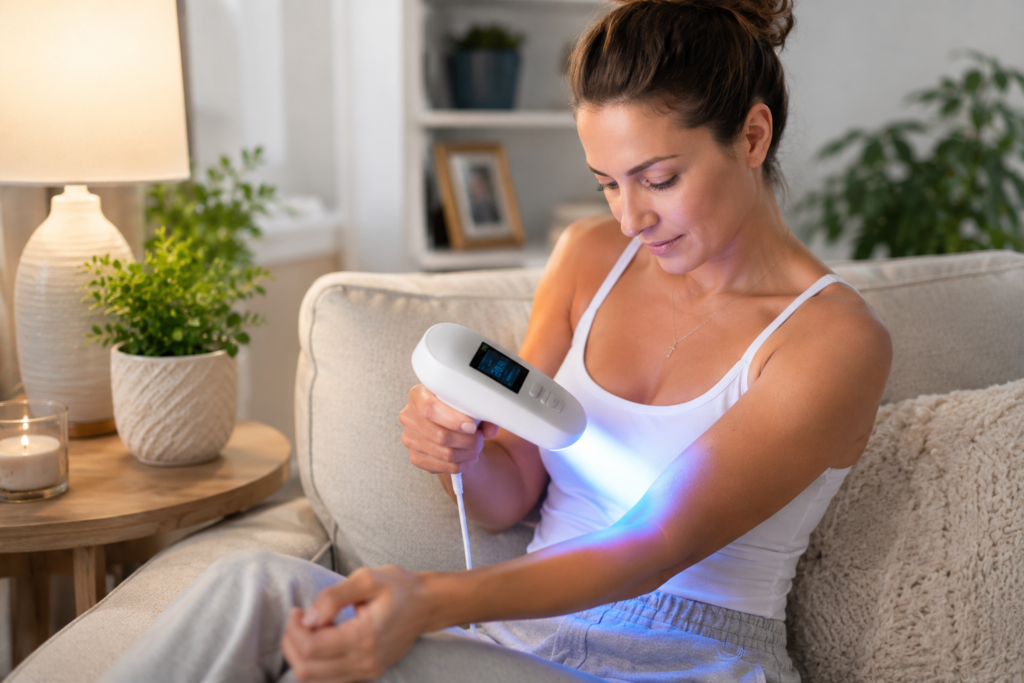
Three form factors cover most prescribing. Handheld 311-nm units, typically built around a 9W Philips PL-S bulb, suit localized plaques, focal vitiligo, and scalp disease with a comb attachment. Tabletop and single-panel systems address regional involvement. Full-body cabinets and three-panel systems – the Daavlin 7-series three-panel used in LITE – are reserved for generalized disease exceeding 10% body surface area (1).
When comparing models, four specifications matter more than marketing copy: peak wavelength at 311 nm (±2 nm), medical-grade Philips TL-01 bulbs or equivalent, IEC 60601-2-57 compliance, and a key-locked controlled prescription timer. CE marking is the European counterpart for cross-border buyers; UL listing addresses electrical safety. A safe UV lamp for home use must ship with UV-blocking goggles in the box, not as an upgrade. Any online seller who skips the prescription requirement should be treated as a red flag.
Safety Guidelines for Home Use
Eye protection is absolute. Thirty seconds of unprotected narrowband UVB can trigger photokeratitis – a corneal burn. Goggles must meet 21 CFR 1040.20 spectral transmittance (below 0.001 from 200–320 nm, below 0.01 from 320–400 nm) and must seal to the face (9). Ordinary sunglasses do not qualify. The joint AAD–NPF 2019 guideline lists eye protection as an A-level recommendation, alongside genital shielding for men during full-body treatment (2).
Dose escalation follows a defined protocol. Starting doses come from minimal erythema dose testing (70% of MED as a near-erythemogenic target), Fitzpatrick phototype tables, or a manufacturer’s fixed-dose schedule. Each session steps up 10 to 20% until sustained mild pinkening appears. Persistent erythema, tenderness, or blistering calls for holding the dose or dropping it by 10 to 25%. Photosensitizing medications – tetracyclines, thiazide diuretics, voriconazole, amiodarone, certain NSAIDs – mandate lower starting doses and closer monitoring. Active lupus erythematosus, xeroderma pigmentosum, and concurrent cyclosporine rule NB-UVB out entirely (2).
For UV therapy at home to stay safe across years of use, scheduled dermatology follow-up – typically every three months – is not optional.
Maintenance and Longevity of Your UV Lamp
Philips rates TL-01 bulbs to 1,000 hours to 50% failure, with output depreciating roughly 10% at 500 hours and 15% at 1,000. Most manufacturers specify bulb replacement between 350 and 800 hours of cumulative use. At typical home frequency, a TL-01 tube lasts five to ten calendar years.
Replace bulbs as a complete set. Mixing aged and new tubes produces uneven irradiance across the treatment field – a classic cause of localized burns at previously safe exposure times. Wipe bulb surfaces with a dry, lint-free cloth only when the device is unplugged and cool. Keep vents clear of dust. Store the unit within 5–40°C and at or below 85% relative humidity, and engage the safety lock between sessions – a feature built into every FDA-cleared home system (10).
Conclusion
Used as prescribed, a home UV lamp gives patients with psoriasis, vitiligo, or atopic dermatitis a clinically validated alternative to frequent clinic visits. The LITE data have closed most of the evidence gap that once restricted insurance coverage and home prescribing (1). Outcomes rest on device quality, 311-nm wavelength accuracy, FDA clearance, and disciplined safety habits. Start with a full dermatologic evaluation, request a written dosing protocol, and select only equipment with verifiable medical clearance and ongoing bulb and service support.
References
-
Gelfand JM, Armstrong AW, Lim HW, et al. Home- vs Office-Based Narrowband UV-B Phototherapy for Patients With Psoriasis: The LITE Randomized Clinical Trial. JAMA Dermatol. 2024;160(12):1320-1328. doi:10.1001/jamadermatol.2024.3897 https://pubmed.ncbi.nlm.nih.gov/39319513/
-
Elmets CA, Lim HW, Stoff B, et al. Joint AAD-NPF guidelines of care for the management and treatment of psoriasis with phototherapy. J Am Acad Dermatol. 2019;81(3):775-804. doi:10.1016/j.jaad.2019.04.042 https://www.jaad.org/article/S0190-9622(19)30637-1/fulltext
-
Rodrigues M, Ezzedine K, Hamzavi I, et al. An update and review of narrowband ultraviolet B phototherapy for vitiligo. Dermatological Reviews. 2025. https://onlinelibrary.wiley.com/doi/full/10.1002/der2.142
-
Musters AH, Mashayekhi S, Harvey J, et al. Phototherapy for atopic eczema. Cochrane Database Syst Rev. 2021;10:CD013870. doi:10.1002/14651858.CD013870.pub2 https://pubmed.ncbi.nlm.nih.gov/34709669/
-
Carretero G, Ferrándiz C, Daudén E, et al. Analysis of the Cost Effectiveness of Home-Based Phototherapy With Narrow-Band UV-B Radiation Compared With Biological Drugs for the Treatment of Moderate to Severe Psoriasis. Actas Dermo-Sifiliográficas. 2012;103(2):127-137. https://www.actasdermo.org/en-analysis-cost-effectiveness-home-based-phototherapy-articulo-S1578219012000649
-
Parrish JA, Jaenicke KF. Action spectrum for phototherapy of psoriasis. J Invest Dermatol. 1981;76(5):359-362. https://pubmed.ncbi.nlm.nih.gov/7229428/
-
Ozawa M, Ferenczi K, Kikuchi T, et al. 312-nanometer ultraviolet B light (narrow-band UVB) induces apoptosis of T cells within psoriatic lesions. J Exp Med. 1999;189(4):711-718. https://pmc.ncbi.nlm.nih.gov/articles/PMC2192929/
-
Johnson-Huang LM, Suárez-Fariñas M, Sullivan-Whalen M, Gilleaudeau P, Krueger JG, Lowes MA. Effective narrow-band UVB radiation therapy suppresses the IL-23/IL-17 axis in normalized psoriasis plaques. J Invest Dermatol. 2010;130(11):2654-2663. https://pubmed.ncbi.nlm.nih.gov/20555351/
-
U.S. Food and Drug Administration. Performance Standard for Sunlamp Products and UV Lamps Intended for Use in Sunlamp Products. 21 CFR 1040.20. https://www.ecfr.gov/current/title-21/chapter-I/subchapter-J/part-1040/section-1040.20
Wang E, Ahad T, Liu YA, Lee TK, Lui H, Crawford RI, Kalia S. Incidence and profile of skin cancers in patients following ultraviolet phototherapy without psoralens: A retrospective cohort study. J Am Acad Dermatol. 2024;90(4):759-766. https://pubmed.ncbi.nlm.nih.gov/38070541/