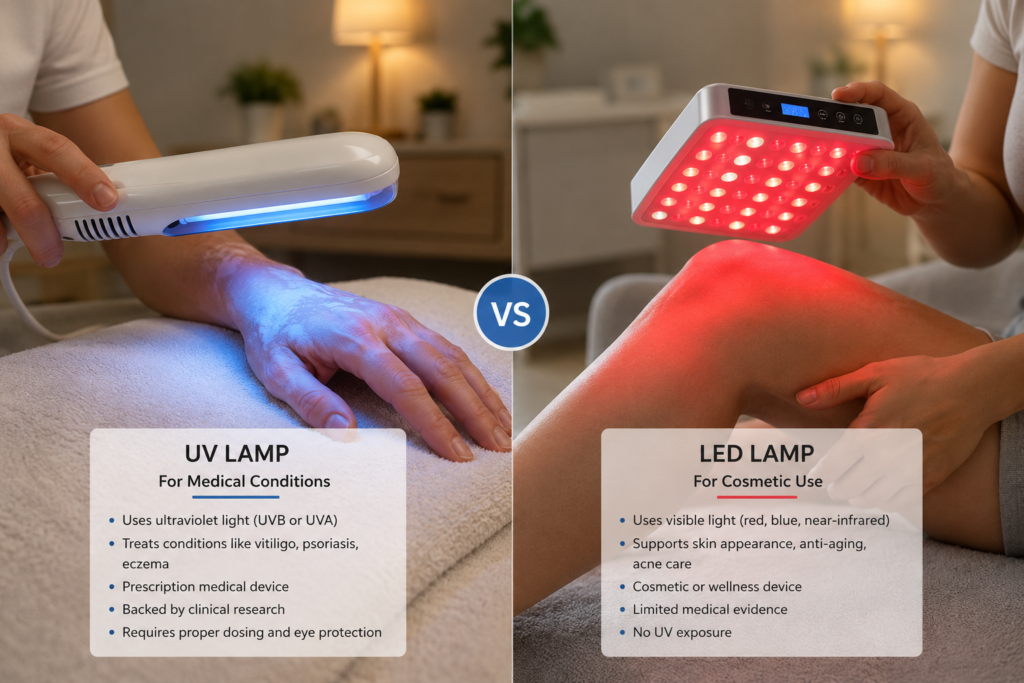

The UV lamp vs LED lamp question lands in my clinic at least once a week. Someone has been scrolling late at night, found both devices on the same retailer, and cannot tell them apart. My short answer is usually the same: the UV lamp for skin treatment is a prescription-grade medical device; most LED panels on those same pages are cosmetic tools. Different physics, different regulatory status, different patients. The longer answer – which we will get into below – covers what UV phototherapy actually does in the skin, where it earns its place in managing vitiligo, psoriasis, and atopic dermatitis, and what changes when a patient asks about treatment at home.
How UV Phototherapy Works
Three bands make up the UV spectrum – UVC (100–280 nm), UVB (280–320 nm), UVA (320–400 nm). UVC never reaches the skin; the atmosphere absorbs it (1). UVB and UVA are the only ones dermatology uses. Back in the early 1980s Parrish and his group narrowed the therapeutic window to 310–313 nm. Efficacy held; the burning wavelengths dropped out (2). That finding is the reason every narrowband UVB lamp sold today – shorthand: UVB 311 nm – peaks exactly there.
“Slows cell division” is the simplified version of the mechanism, and it undersells what is happening. Reich and Mędrek traced the absorption: about 90% of NB-UVB is soaked up by the epidermis, and the downstream effects involve keratinocyte apoptosis, Langerhans cell depletion, and a shift in cytokine signaling across Th1, Th2, Th17, and Th22 pathways (2). In vitiligo, the same radiation wakes up melanocyte precursors sitting quietly in the outer root sheath, which is why pigment comes back first in little rings around hair follicles (3).
Skin Conditions Treated with UV Lamps
A UV lamp for vitiligo works on two levels at once. CXCL9 and CXCL10 – the chemokines pulling cytotoxic T cells into depigmented patches – get turned down, and follicular melanocyte precursors start dividing. Bishnoi and colleagues pulled the numbers together: roughly 80% response on the face, trunk, and proximal limbs, dropping to around 11% on hands and feet (3). Fewer follicles, less regrowth. Patients need to hear that early. Repigmentation takes months, and relapse happens.
The case for a UV lamp for psoriasis rests on the 2019 AAD–NPF joint guideline. Elmets and colleagues cite meta-analytic data showing about 62% of patients reach PASI 75 on NB-UVB monotherapy, and the guideline explicitly supports home-based NB-UVB for adults with generalized plaque disease when the patient is a reasonable candidate (4).
Atopic dermatitis is the softer recommendation. The 2024 AAD guideline kept phototherapy at “conditional” for moderate-to-severe disease not controlled by topicals – NB-UVB being the form actually used in practice (5). Mechanistically it knocks down Th2 and Th22 signaling, drops Staphylococcus aureus density on the skin, and lets filaggrin and other barrier proteins normalize in the stratum corneum (5). None of that cures anyone. It calms the disease. And it should not start without a dermatologist in the loop.
Benefits of UV Lamps for Skin Therapy
The appeal of NB-UVB, set against biologics and systemic immunosuppressants, is mostly what it does not do. No ongoing immunosuppression. No monthly labs. Remission in responders often lasts. A UVB phototherapy device can sit in a clinic as a booth, come out as a handheld wand for a single plaque, or serve as a home phototherapy device for patients who cannot drive in three times a week. Anderson and Feldman point out that Medicare picks up 80% of UV panel costs for qualifying patients, and randomized comparisons have shown home NB-UVB matching hospital PASI outcomes (6).
UV Lamp vs LED Lamp: What’s the Difference?
A UV lamp in dermatology means ultraviolet output – almost always a narrowband UVB lamp peaked at 311–313 nm. The FDA puts these under 21 CFR 878.4630 as Class II devices with 510(k) clearance tied to specific diagnoses, and the clearance letter typically restricts use to physician direction (7).
LED devices are a different story entirely. They emit visible or near-infrared light – blue near 415 nm, red at 630–660 nm, near-infrared between 760 and 1200 nm – and no UV at all in any reputable design (8). Where the FDA has cleared them, the indication is usually periorbital wrinkles or mild-to-moderate acne.
The gap in evidence is bigger than the retailer pages suggest. UV lamps act through immunomodulation and controlled cytotoxicity, and the trial base behind them goes back decades. LED works through photobiomodulation – cytochrome c oxidase activation, transient ATP and reactive oxygen species changes, nitric oxide signaling in fibroblasts (9). Jagdeo and colleagues reviewed 31 RCTs and gave LED grade B for acne vulgaris, herpes simplex and zoster, and acute wound healing; most other indications came in at grade C or lower (9). Nothing in that literature positions LED as an alternative to UVB for chronic inflammatory skin disease.
So for vitiligo, plaque psoriasis, and moderate-to-severe atopic dermatitis, the device that has the evidence is a certified UVB phototherapy device. LED has its own lane – cosmetic dermatology, adjunctive care – and it performs well there.
Types of UV Lamps Used in Dermatology
NB-UVB at 311–313 nm is what modern phototherapy units use. It keeps the output inside the therapeutic range and cuts the shorter wavelengths that caused most of the erythema in older equipment (2). Broadband UVB (290–320 nm) is mostly retired, though a few clinics still run it for patients who, oddly, do better on the wider spectrum (4). PUVA – psoralen plus UVA – is the older route, and its higher cumulative cancer risk has pushed it into narrow, refractory indications.
How to Choose a UV Lamp
Certification first. For U.S. purchase, FDA 510(k) clearance under 21 CFR 878.4630; for Europe, CE marking; and IEC 60601 medical-electrical compliance across the board (7). Read the Indications for Use on the clearance letter, not the product page – clearance for psoriasis does not mean clearance for vitiligo. Peak output should sit at UVB 311 nm; “full-spectrum” with no wavelength listed is a red flag. Form factor tracks lesion distribution – booth for generalized, panel for palms and soles, handheld for a small patch of vitiligo. And dosing belongs to the dermatologist, calculated from minimal erythema dose or Fitzpatrick phototype. Never to the patient.
Safety Guidelines
Goggles at every session – non-negotiable. Wavelengths between 295 and 320 nm are a known contributor to photokeratitis and lens opacities (10). Genital shielding goes on for whole-body treatment. Starting dose typically sits at 70% of MED or follows a fixed phototype chart. Tanning beds, unprotected sun, and photosensitizing medications – some antibiotics, diuretics, retinoids – either add to the dose or lower the burn threshold. Contraindications I always screen for: lupus, xeroderma pigmentosum, porphyria, melanoma history, multiple non-melanoma skin cancers (4)(10).
This article is educational. It does not replace a consultation. Any phototherapy – in-office or at home – should begin with a dermatologist.
Conclusion
The UV lamp vs LED lamp debate only looks like a debate when you lump them into one category. They are not one category. For vitiligo, psoriasis, and atopic dermatitis, NB-UVB is where the evidence is, where the guidelines point, and where I send my own patients. LED has a place – cosmetic, adjunctive – and it does that job honestly. But it does not replace a UVB phototherapy device. See a dermatologist before you spend.
References
-
World Health Organization. Radiation: Ultraviolet (UV) radiation. https://www.who.int/news-room/questions-and-answers/item/radiation-ultraviolet-(uv)
-
Reich A, Mędrek K. Effects of narrow band UVB (311 nm) irradiation on epidermal cells. Int J Mol Sci. 2013;14(4):8456–8466. https://www.ncbi.nlm.nih.gov/pmc/articles/PMC3645754/
-
Bishnoi A, Vinay K, Parsad D. Phototherapy for vitiligo. Photodermatol Photoimmunol Photomed. 2024;40(3):e12968. https://pubmed.ncbi.nlm.nih.gov/38632705/
-
Elmets CA, Lim HW, Stoff B, et al. Joint AAD–NPF guidelines for psoriasis with phototherapy. J Am Acad Dermatol. 2019;81(3):775–804. https://www.jaad.org/article/S0190-9622(19)30637-1/fulltext
-
Davis DMR, Drucker AM, Alikhan A, et al. Guidelines for atopic dermatitis in adults with phototherapy and systemic therapies. J Am Acad Dermatol. 2024;90(2):e43–e56. https://www.jaad.org/article/S0190-9622(23)02879-7/fulltext
-
Anderson KL, Feldman SR. A guide to prescribing home phototherapy for patients with psoriasis. J Am Acad Dermatol. 2015;72(5):868–878. https://pubmed.ncbi.nlm.nih.gov/25748310/
-
U.S. Food and Drug Administration. 21 CFR 878.4630 – Ultraviolet Lamp for Dermatologic Disorders. https://www.ecfr.gov/current/title-21/chapter-I/subchapter-H/part-878/subpart-E/section-878.4630
-
Guo Y, Qiu L, Gao F, et al. LED in cosmetic dermatology. Photodermatol Photoimmunol Photomed. 2025;41(3):e70041. https://onlinelibrary.wiley.com/doi/10.1111/phpp.70041
-
Jagdeo J, Austin E, Mamalis A, et al. Light-emitting diodes in dermatology: a systematic review of RCTs. Lasers Surg Med. 2018;50(6):613–628. https://pubmed.ncbi.nlm.nih.gov/29356026/
-
UVB Phototherapy. DermNet NZ; 2023. https://dermnetnz.org/cme/phototherapy/uvb-phototherapy