
Introduction
Phototherapy is older than most of the drugs that compete with it. What has changed recently is patient demand – more people want options that don’t involve a biologic injection or a topical steroid taper. Narrowband UVB devices at 311 nm have absorbed most of that interest. They turn up in clinic cabinets, on dermatology referral pathways, and on kitchen tables, treating psoriasis, vitiligo, atopic dermatitis and several other inflammatory conditions (1). LED panels get mentioned in the same breath, but the physics aren’t the same and neither are the indications.
How UV Lamps Work for Skin Conditions
Modern UV skin therapy relies on tightly defined wavelengths rather than the broadband sources of decades past – and the difference between bands matters clinically. Three bands make up the UV spectrum – UVC (100–280 nm), UVB (280–315 nm), UVA (315–400 nm). UVC barely matters in dermatology; the ozone layer absorbs it before it can reach the ground, and while it kills bacteria efficiently it has no role on patient skin (2). UVB stops at the epidermis and the very top of the dermis. UVA carries on through, down to the fibroblasts and dermal vessels in the deeper layers (3).
The mechanism is not single. UVB hits keratinocyte and T-cell DNA, generates cyclobutane pyrimidine dimers, and pushes pathogenic lymphocytes into apoptosis; downstream of that, IL-17 and IL-23 production falls (4). Langerhans cell counts in the epidermis drop too. The vitiligo response runs on a different track – UVB nudges melanocytes out of the hair-follicle reservoir and switches melanogenesis back on, which is what repigmentation actually is, mechanically
UV Therapy for Psoriasis and Eczema
Narrowband UVB at 311 nm is the workhorse for psoriasis. The wavelength was selected after the action-spectrum studies of the late 1970s and 1980s – Fischer, then Parrish and Jaenicke – which showed that 296–313 nm cleared psoriasis without producing the erythema that broadband sources caused at therapeutic doses (6). Modern fluorescent lamps (Philips TL-01 and equivalents) deliver a peak at 311 ± 2 nm. Clearance rates in chronic plaque psoriasis are high when patients adhere to a typical 2–3-session-per-week schedule, with TL-01 lamps proving significantly more effective than conventional broadband sources in controlled half-body comparisons (7).
Atopic dermatitis has thinner evidence behind UVB, but what exists is consistent. The American Academy of Dermatology lists NB-UVB as second-line when topicals run out of road. Cochrane reviewers found 12-week improvements in physician-rated severity, itch and patient-reported symptoms against placebo, and withdrawal rates from adverse events were not materially different between the arms (8).
UV Lamps for Acne and Bacterial Control
The UV lamp acne question comes up in clinic more often than the evidence really supports – patients see home devices marketed for breakouts and assume UV is part of the toolkit. Conventional UVB isn’t part of standard acne care. There is anti-inflammatory action, yes, but the carcinogenicity trade-off doesn’t pencil out when topical retinoids, peroxides and oral options already exist. The UV phototherapy that actually moves the needle in acne is visible light. Blue near 415 nm excites endogenous porphyrins inside Cutibacterium acnes; the resulting reactive oxygen burst kills the organism (9). One 107-patient randomised trial recorded a mean 76% drop in inflammatory lesions after 12 weeks of combined blue (415 nm) and red (660 nm) light – a better result than benzoyl peroxide cream in the same study (10).
Limitations and Safety
Nothing about UV is curative. Stop treating psoriasis and it comes back. Vitiligo repigmentation moves slowly and is patchy at best on the hands, feet and bony prominences – these areas simply respond less (11). Short-term complications are predictable: erythema, dryness, mild burns, some transient hyperpigmentation. Emollients handle most of it (12). Goggles every session, no exceptions – cataract risk is real with chronic exposure. Longer-term worries are photoaging and the question of non-melanoma skin cancer, though the Taiwanese cohort of more than 22,000 psoriasis patients did not find a significant excess of skin cancer in long-term NB-UVB users (13). BAD guidance still calls for surveillance once a patient crosses 500 whole-body treatments (14). Anyone with a prior melanoma, a photosensitive disorder or a current photosensitising drug needs a pre-treatment assessment before being put on a lamp.
UV vs LED Lamp for Skin Therapy
UV vs LED lighting devices both deliver light, but they are not interchangeable.
Wavelength & Effectiveness
UV lamp for skin conditions runs in the ultraviolet – 311 nm for NB-UVB, 308 nm for excimer. LED panels and masks sit in the visible spectrum: blue near 415–470 nm, red near 630–660 nm, occasionally near-infrared at around 830 nm. UV interacts with skin immunology and rewrites cell behaviour at the level of DNA. LED works by chromophore absorption – porphyrins picking up blue light, cytochrome c oxidase picking up red – and the result is gentler but also narrower in what it can do clinically (15). No published LED protocol has matched NB-UVB outcomes in psoriasis or vitiligo.
Safety & Comfort
LED devices generate negligible heat and carry no ionising or UV risk, which is why they are sold over the counter without medical oversight. UV lamps require dosimetry, graded increases in exposure, eye shielding and clinical supervision. Burns are uncommon when patients follow protocol – but they happen when someone doubles a session out of impatience.
Lifespan & Maintenance
Service life on Philips NB-UVB tubes lands around 1,000–2,000 hours of useful output; after that, irradiance falls below therapeutic levels and the tube needs swapping out. Excimer xenon-chloride sources have a more complex maintenance profile but offer high fluences in a small treatment field. LED arrays last considerably longer – often 25,000 hours or more – though their per-diode output decays slowly and is rarely measured by end users.
Use Cases & Recommendations
UVB is the appropriate tool for psoriasis, vitiligo and refractory atopic dermatitis. LED is the appropriate tool for mild-to-moderate acne, post-procedure inflammation and adjunctive photoaging treatment. Patients who present asking for “a light therapy lamp” usually need a clinician to translate their condition into the correct technology before they spend money.
Top UV Lamps for Skin Therapy (Current Models)
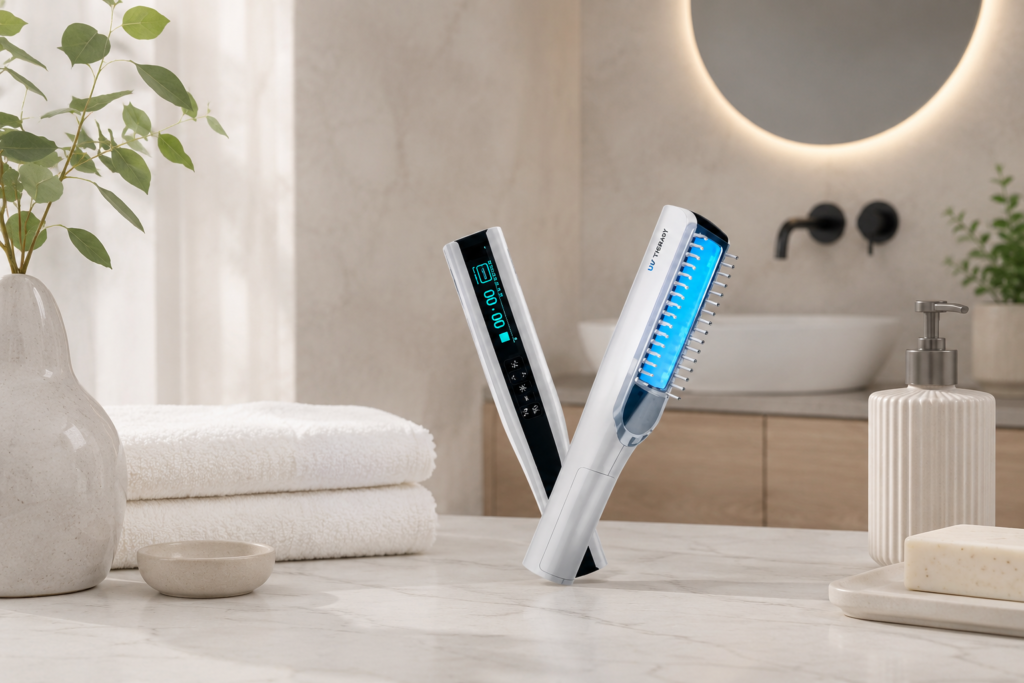
The professional UVB device landscape has consolidated around a small group of manufacturers. The KERNEL KN-4003BL handheld 311 nm lamp (Philips bulb, ~9 W) is a common entry point for localised psoriasis, vitiligo and eczema patches; portable and quiet, it suits patients who cannot attend frequent clinic visits (16). For larger treatment areas, panel and cabinet systems such as the KN-4006B series and the full-body KN-4004B1 use multiple Philips TL-01 lamps and deliver irradiation areas from approximately 540 cm² up to whole-body coverage. Excimer systems – the KN-5000C and KN-5000D – emit a monochromatic 308 nm beam suitable for stubborn focal lesions, where high fluences and selectivity matter most. Each of these devices is intended for use under a dermatologist’s protocol, not as an off-the-shelf consumer purchase.
Tips for Safe Use of UV Lamps on Skin
A safe UV lamp for skin use is only as safe as the protocol around it – the bulb does the work, but the timer, dosimetry and clinician guidance are what keep treatment from going wrong. Read the protocol your prescriber gives you before the first session. Wear UV-rated goggles every time. Start at the recommended dose for your Fitzpatrick skin type – never higher. Keep the lamp surface clean and check tube hours periodically; output drops as bulbs age. Do not use UV on broken skin, open lesions or recent tattoos. Avoid treatment if you have taken a photosensitising drug (tetracyclines, certain diuretics, oral retinoids) without clearing it with your physician. If erythema persists more than 24 hours after a session, hold the next one and call the clinic.
Conclusion
UV lamp psoriasis have a defined, well-evidenced place in dermatologic care – particularly for psoriasis, vitiligo and atopic dermatitis. LED devices fill a different niche, mostly around acne, photoaging and skin recovery. Choosing between them is rarely a real choice; it depends on the diagnosis. The lamp matters less than wavelength, dose discipline, eye protection and clinical supervision. Patients who follow protocol get the benefit; those who improvise tend to find out why the protocol exists in the first place.
References
-
Penn Medicine. Phototherapy for Skin Conditions. pennmedicine.org/treatments/phototherapy
-
World Health Organization. Radiation: Ultraviolet (UV) radiation. Q&A document.
-
Bolton et al. The role and safety of UVA and UVB in UV-induced skin erythema. Frontiers in Medicine (PMC10335810).
-
Ozawa M, Ferenczi K, Kikuchi T, et al. 312-nanometer Ultraviolet B Light (Narrow-Band UVB) Induces Apoptosis of T Cells within Psoriatic Lesions. J Exp Med (PMC2192929).
-
Mohammad TF, Al-Jamal M, Hamzavi IH, et al. The Vitiligo Working Group recommendations for narrowband UVB phototherapy treatment of vitiligo. PubMed PMID 28216034.
-
Mehta D, Lim HW. Narrowband UVB in the treatment of psoriasis: the journey so far. Indian J Dermatol Venereol Leprol (ijdvl.com).
-
Green C, Ferguson J, Lakshmipathi T, Johnson BE. 311 nm UVB phototherapy – an effective treatment for psoriasis. PubMed PMID 3203066.
-
Musters AH, Mashayekhi S, Harvey J, et al. Phototherapy for atopic eczema. Cochrane Database Syst Rev (PMC8552896).
-
Sadowska M, Narbutt J, Lesiak A. Blue Light in Dermatology. Life (Basel) (PMC8307003).
-
Papageorgiou P, Katsambas A, Chu A. Phototherapy with blue (415 nm) and red (660 nm) light in the treatment of acne vulgaris. Br J Dermatol 2000;142:973-8.
-
Wang Y, Li S, Li C. An update and review of narrowband UVB phototherapy for vitiligo. Dermatological Reviews 2022.
-
DermNet NZ. UVB Phototherapy. dermnetnz.org/topics/uvb-phototherapy
-
Lee E, Koo J, Berger T. Long-term NB-UVB phototherapy and skin cancer risk in psoriasis: Taiwanese population-based cohort study. PubMed PMID 30536640.
-
Robbins HL, et al. Mutation burden of narrowband UVB phototherapy in human skin: relevance to lifetime exposures and skin cancer surveillance. Br J Dermatol 2025 (PMC12448954).
-
Sorbellini E, Rucco M, Rinaldi F. Photodynamic and photobiological effects of LED therapy in dermatological disease: an update. Lasers Med Sci 2018 (PMC6133043).
-
UVTREAT / Kernel Medical Equipment product catalogue, 2026. uvtreat.com