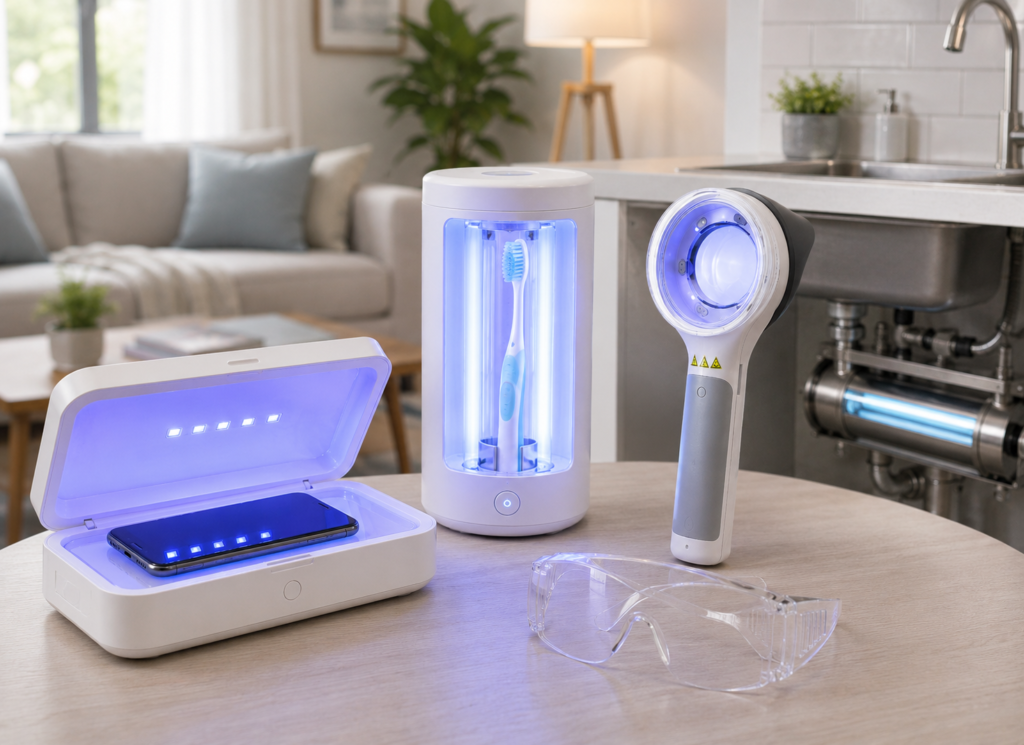

In my dermatology practice, I’m asked about home UV devices nearly every week – UV phone sanitizers, toothbrush chambers, under-sink water systems, and portable wands sold online. Pandemic-era interest never really faded. Patients bring me the packaging, sometimes the device itself, and ask whether it’s safe. I take the question seriously. The same stretch of the electromagnetic spectrum I use to treat psoriasis and vitiligo can, at different wavelengths and doses, burn a cornea or scorch the epidermis. Product quality matters here more than most consumers appreciate.
What follows is what I tell patients who are weighing a UV lamp purchase – which UV light applications are actually backed by evidence, where the real hazards lie, and how to tell a credible product from one the FDA has already flagged. Sources are FDA, EPA, CDC, NSF, and ICNIRP only. Nothing here relies on manufacturer marketing or secondary summaries.
What Is UV Light and How Does It Work?
UV sits between visible light and soft X-rays on the electromagnetic spectrum, running from about 100 to 400 nm. Three sub-bands matter for this discussion: UVA (315–400 nm), UVB (280–315 nm), and UVC (100–280 nm) (1). The atmosphere absorbs UVC almost entirely, and most of the UVB too. What reaches your skin outdoors is mainly UVA with a small UVB component – which means any UVC a person encounters indoors is coming from something plugged into a wall (1).
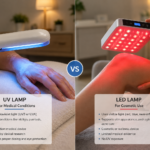
Two very different things get called “UV” in everyday speech, and the conflation causes trouble. Therapeutic UV – what I prescribe for psoriasis, vitiligo, atopic dermatitis – is narrowband UVB delivered around 311 nm, cabinet-based, dosed by body-surface area, administered in a clinic. Germicidal UV is another creature entirely: shorter wavelength, higher photon energy, never meant to contact human tissue. UVC photons in the 240–280 nm range are absorbed by microbial DNA and RNA and form pyrimidine dimers that shut down replication (1, 6). Consumer germicidal devices mostly rely on low-pressure mercury lamps, which throw roughly 90% of their energy at 253.7 nm – a wavelength chosen precisely because it lands inside the peak-kill window (1).
CDC added formal recognition of ultraviolet germicidal irradiation (UVGI) to its environmental infection-control guidance in 2003 (6), though hospitals had been running UV air-disinfection systems since the late 1930s (10). The history is real. Whether any given home device draws on that history in a useful way is a separate question entirely.
One critical point I emphasize with patients: UVC does not pass through glass, soiled surfaces, or turbid water. If a microorganism is shielded by dust, biofilm, or a fingerprint smudge, it will not be inactivated (1).
Everyday Uses of UV Light at Home
The UV light uses I consider defensible in a home, listed in approximate order of the evidence supporting each:
-
Water purification. Point-of-use and point-of-entry UV systems expose flowing water to 254 nm radiation inside a sealed chamber, inactivating bacteria, viruses, and chlorine-resistant protozoa including Cryptosporidium and Giardia (7, 9). EPA recognizes UV as an effective drinking-water disinfection method (9), and in the US the consumer standard to look for is NSF/ANSI 55 (7). This is the one residential application where I tell patients UV is doing real, measurable work.
-
In-duct HVAC UVGI. Ultraviolet lamps inside air handlers suppress microbial growth on cooling coils, drain pans, and ductwork (3, 5). EPA is explicit that these supplement HEPA or MERV-13 filtration – they don’t replace it (3, 4).
-
Enclosed small-item sanitizers. Closed UV chambers for toothbrushes, pacifiers, CPAP accessories, or retainers deliver a short dose inside a sealed box that shuts off when opened. Low-risk when the interlock functions.
-
UV phone and key boxes. The same principle applied to electronics; most consumer home UV light gadgets on the US market fall here.
-
Private-well treatment. For households on well water, a whole-house UV sterilizer paired with sediment and carbon pre-filtration provides continuous, chemical-free disinfection (7, 9). This is probably the most clinically meaningful home sterilizer USA application I encounter in rural patients.
Safety Tips for UV Disinfection at Home
Patient safety is where most of my UV conversations end up. The FDA’s 2022 safety communication documented that certain handheld UV wands emitted UV-C at roughly 3,000 times the ICNIRP recommended exposure limit at two inches’ distance – enough to injure skin or eyes within seconds (2, 8). Any UV lamp for daily use carries real risk if containment fails.
In my practice I’ve seen patients present with delayed-onset erythema and a sandy, foreign-body sensation in the eyes after handling these products – classic photokeratitis and UV-induced skin reaction (1). The symptoms typically appear several hours after exposure, which is why users often don’t connect the two.
Clinical safety checklist I give patients:
-
Never look directly at an operating UV-C source, even briefly. Wear UV-rated eyewear when inspecting any device.
-
Keep bare skin out of the beam. There is no therapeutic benefit to incidental home UVC exposure – only cumulative DNA damage in exposed keratinocytes.
-
Use timers and door interlocks. A device without automatic shutoff on opening is not appropriate for household use.
-
Verify certifications. Look for UL or ETL listings for electrical safety, NSF/ANSI 55 for water systems (7), and FDA-registered manufacturers for any disinfection claim. FDA treats “disinfects in seconds” marketing as a red flag in itself (2).
-
Ventilate if ozone is produced. Some UV lamps emit 185 nm light that generates ozone, a respiratory irritant; EPA recommends keeping indoor ozone below 0.05 ppm (3).
-
Keep children and pets away. Pediatric skin and ocular tissue are more vulnerable to UV injury.
-
Dispose of broken mercury-containing lamps as household hazardous waste.
Benefits of Using UV Light Daily
When the containment and certification criteria are met, ultraviolet disinfection offers real advantages over chemical methods. It leaves no residue – meaningful for electronics, pediatric items, and food-contact surfaces. It produces no fragrance that can provoke contact dermatitis or reactive airway disease in sensitive patients, a recurring problem I see with heavily scented cleaning products. Maintenance is modest: a typical under-sink UV system needs one lamp change per year (7, 9).
UVGI is the same core technology used in US hospitals, food-processing facilities, and municipal water utilities for decades (6, 10). A properly certified UV cleaning lamp at home operates on the same physics at smaller scale. The efficacy is real; the question is always whether a specific device delivers the specified dose to the specified target.
Limitations and Precautions
UV only acts on what it directly illuminates. Toothpaste on a brush, fingerprint films on a phone, or dust on HVAC coils all shield microbes from the beam (1). I tell patients: clean first, UV second.
EPA has been candid that typical residential UVGI air cleaners deliver limited reductions in airborne bacteria and generally cannot provide the exposure needed to inactivate mold or bacterial spores (3, 5). In practical terms, UV supplements filtration and ventilation – it doesn’t replace either.
Finally, marketing in the UV sterilization USA consumer market routinely outruns the evidence. The FDA’s defect-notice list includes multiple handheld UV wand products found to emit unsafe UV-C radiation (2). I recommend patients check that list against any portable UV product they’re considering.
Conclusion
My practical view after years of fielding these questions: a well-chosen UV lamp has a place in the home, and UV disinfection at home is not snake oil when done properly. The shortlist for patients is simple. Enclose the source. Buy from manufacturers willing to publish third-party test data. Insist on UL or ETL for electrical safety, NSF/ANSI 55 for any water system. Be suspicious of anything promising disinfection in seconds – the FDA has already named names on that front (2). UV belongs in a home as one more layer, next to handwashing, HEPA filtration, and good ventilation. It isn’t a replacement for any of them, and in my view it never will be.
References
-
U.S. Food and Drug Administration. UV Lights and Lamps: Ultraviolet-C Radiation, Disinfection, and Coronavirus. https://www.fda.gov/medical-devices/coronavirus-covid-19-and-medical-devices/uv-lights-and-lamps-ultraviolet-c-radiation-disinfection-and-coronavirus
-
U.S. Food and Drug Administration. Do Not Use Ultraviolet (UV) Wands That Give Off Unsafe Levels of Radiation: FDA Safety Communication. July 20, 2022. https://www.fda.gov/medical-devices/safety-communications/do-not-use-ultraviolet-uv-wands-give-unsafe-levels-radiation-fda-safety-communication
-
U.S. Environmental Protection Agency. Guide to Air Cleaners in the Home. EPA 402-F-08-004. https://www.epa.gov/indoor-air-quality-iaq/guide-air-cleaners-home
-
U.S. Environmental Protection Agency. What is Upper-Room Ultraviolet Germicidal Irradiation (UVGI)? https://www.epa.gov/indoor-air-quality-iaq/what-upper-room-ultraviolet-germicidal-irradiation-uvgi-what-hvac-uvgi-can
-
U.S. Environmental Protection Agency. Residential Air Cleaners (Second Edition): A Summary of Available Information. EPA 402-F-09-002. https://www.epa.gov/indoor-air-quality-iaq/air-cleaners-and-air-filters-home
-
U.S. Centers for Disease Control and Prevention. Guidelines for Environmental Infection Control in Health-Care Facilities. 2003; UVGI supplementary guidance. https://www.cdc.gov/infection-control/hcp/environmental-control/index.html
-
NSF International. NSF/ANSI 55: Ultraviolet Microbiological Water Treatment Systems. https://www.nsf.org/consumer-resources/articles/standards-water-treatment-systems
-
International Commission on Non-Ionizing Radiation Protection (ICNIRP). Guidelines on Limits of Exposure to Ultraviolet Radiation of Wavelengths Between 180 nm and 400 nm (Incoherent Optical Radiation). Health Physics 87(2):171-186; 2004. https://www.icnirp.org/en/publications/article/icnirp-publications-1992-2004.html
-
U.S. Environmental Protection Agency. Ultraviolet Disinfection Guidance Manual for the Final Long Term 2 Enhanced Surface Water Treatment Rule. EPA 815-R-06-007, November 2006. https://www.epa.gov/dwreginfo/long-term-2-enhanced-surface-water-treatment-rule-documents
-
Kowalski W. Ultraviolet Germicidal Irradiation Handbook: UVGI for Air and Surface Disinfection. Springer-Verlag, 2009. https://link.springer.com/book/10.1007/978-3-642-01999-9